The 5 types of lipedema (I–V)
Types describe where the fat is — not how bad it is.
- Researched against current medical guidelines
- Every claim sourced & linked to a named authority
- Independent — we don’t sell surgery
- Not a substitute for your doctor.
Lipedema "types" describe where the abnormal fat is located, not how severe it is. Type I is the hips and buttocks; Type II to the knees; Type III to the ankles (the most common); Type IV the arms; Type V the lower legs only.
On this page
What are the five types of lipedema?
Lipedema is classified into five types based on which parts of the body the abnormal fat occupies. The classification was introduced to help clinicians describe distribution — it does not indicate severity, stage, or prognosis. Most people have elements of more than one type. (Herbst et al. Phlebology 2021)
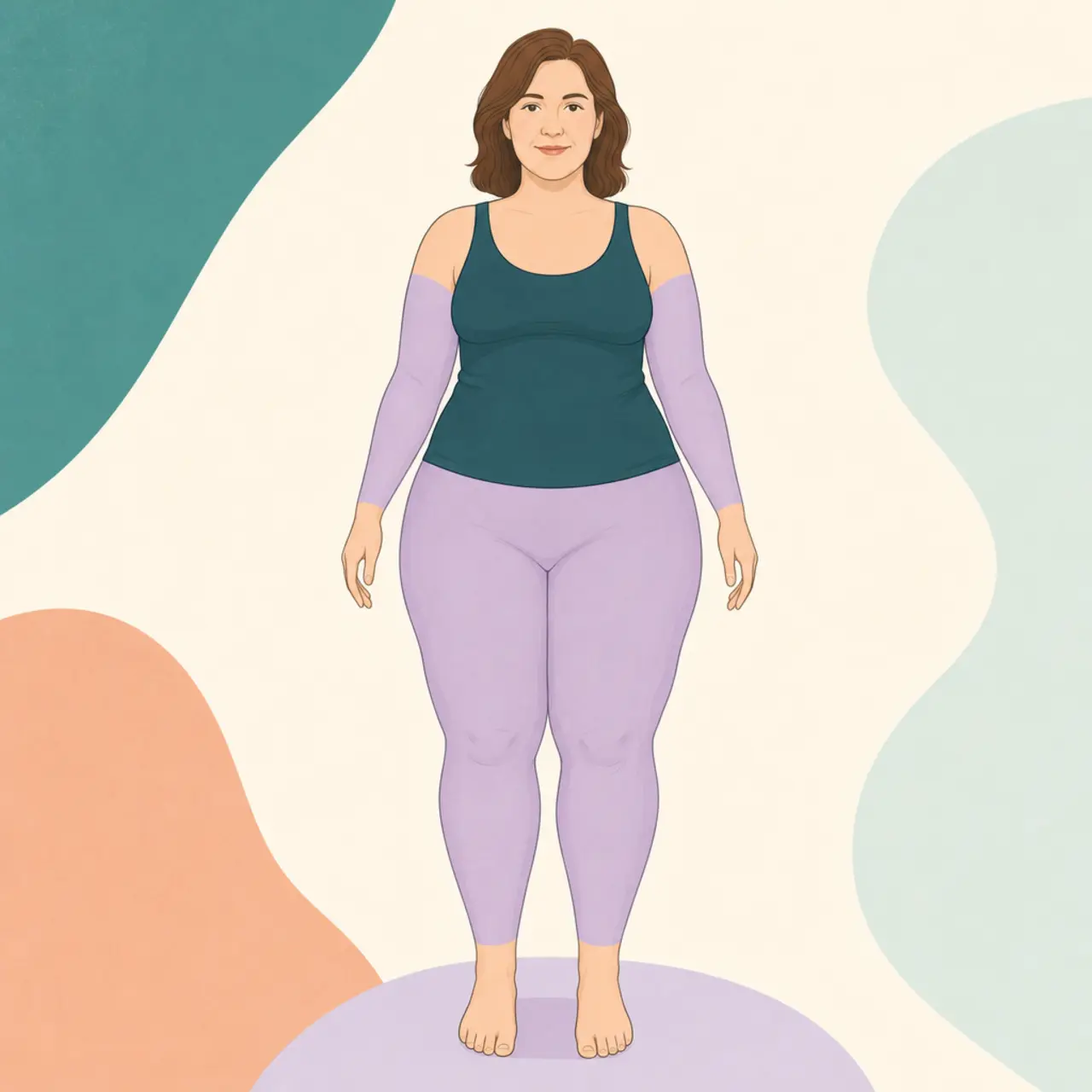
| Type | Fat distribution | Notes |
|---|---|---|
| Type I | Hips, buttocks, and pelvic area | May be overlooked as "big hips" |
| Type II | Buttocks down to and including the knees; inner-knee lobes common | Inner-knee fat pads are a hallmark |
| Type III | Buttocks down to the ankles | The most common type; full-leg involvement |
| Type IV | Arms — upper arm and sometimes forearm; usually alongside a leg type | Often presents with the cuff sign at the wrist |
| Type V | Lower legs only (below the knee) | A rarer isolated pattern; can overlap with lipo-lymphedema |
Type I — Hips and buttocks
In Type I, abnormal fat accumulates primarily in the hips, buttocks, and lower pelvis. The upper legs and feet are not affected. Because the lower body is naturally larger in many women, Type I is frequently missed or attributed to "body shape" rather than recognized as a medical condition.
- Fat is symmetrical on both hips
- Buttocks and hips may feel disproportionately heavy or sore
- Waistline may look markedly smaller by comparison
- Legs below the hips appear normal in this type alone
Type II — Buttocks to the knees
Type II extends from the buttocks to the knees and is recognized by the characteristic fat pads that form on the inner sides of the knees. These inner-knee lobes can cause discomfort when walking and may rub together.
- Fat fills the thighs from hip to knee
- Distinctive inner-knee fat pads
- Lower legs and feet remain their normal size
- Gait may be affected by inner-thigh and knee friction
Type III — Buttocks to the ankles (the most common type)
Type III is the most common form of lipedema, with fat extending from the hips all the way to the ankles. The cuff sign is especially visible here — the fat ends sharply at the ankle, leaving the foot its normal size. This abrupt line is one of the strongest visual indicators of lipedema.
- Both legs affected symmetrically from hip to ankle
- The cuff sign at the ankle is prominent
- Feet are noticeably smaller than the affected legs above
- Heaviness and pain throughout the leg are common
Type IV — Arms
Type IV involves the arms — typically the upper arms and sometimes the forearms. It almost always appears alongside a leg type rather than in isolation. The same cuff-sign phenomenon occurs at the wrist: the swollen, fatty arm ends at the wrist joint, leaving the hand its normal size.
- Both arms affected symmetrically
- Upper arms feel heavy, soft, and tender
- A cuff sign may appear at the wrist
- Arms bruise very easily with minor contact
- Most people with Type IV also have Type I, II, or III in the legs
Type V — Lower legs only
Type V is the least common isolated type, affecting only the lower legs below the knee. Because it may look more like ankle swelling than classic lipedema, it can be confused with lymphedema or other causes of leg swelling. When lymphatic involvement is significant, it may be classified as lipo-lymphedema. (Herbst et al. 2021)
Type V and lymphedema overlap.
The lower-leg pattern is where lipedema and lymphedema are most easily confused. A specialist evaluation is especially important with isolated lower-leg involvement.
Can you have more than one type?
Yes — and it's common. Many people have a combination of types, the most frequent being Types I+II+III together (full leg involvement from hip to ankle) or Types II/III + IV (legs and arms). When multiple types are present, a doctor will usually note all applicable types rather than choosing just one.
Types vs stages — different things.
Types describe location; stages describe severity and tissue texture. You can be Type III Stage 1 (legs fully involved but tissue still smooth) or Type I Stage 3 (only hips, but with advanced fibrotic, lobular tissue). They are separate dimensions.
Does your type affect treatment?
The fundamental treatment approach — compression, manual lymphatic drainage, anti-inflammatory lifestyle, and where appropriate surgery — applies across all types. However, type does influence specifics: arm involvement (Type IV) requires garments fitted for the arms, surgical techniques differ slightly for arms versus legs, and Type V requires particular care to distinguish from lymphedema before treatment begins. (Herbst et al. 2021)
Sources
- Herbst KL et al. US Standard of Care for Lipedema — Phlebology 2021 journals.sagepub.com
- Aday AW et al. Lipedema survey — Vascular Medicine 2024 pmc.ncbi.nlm.nih.gov
- Lipedema Foundation lipedema.org