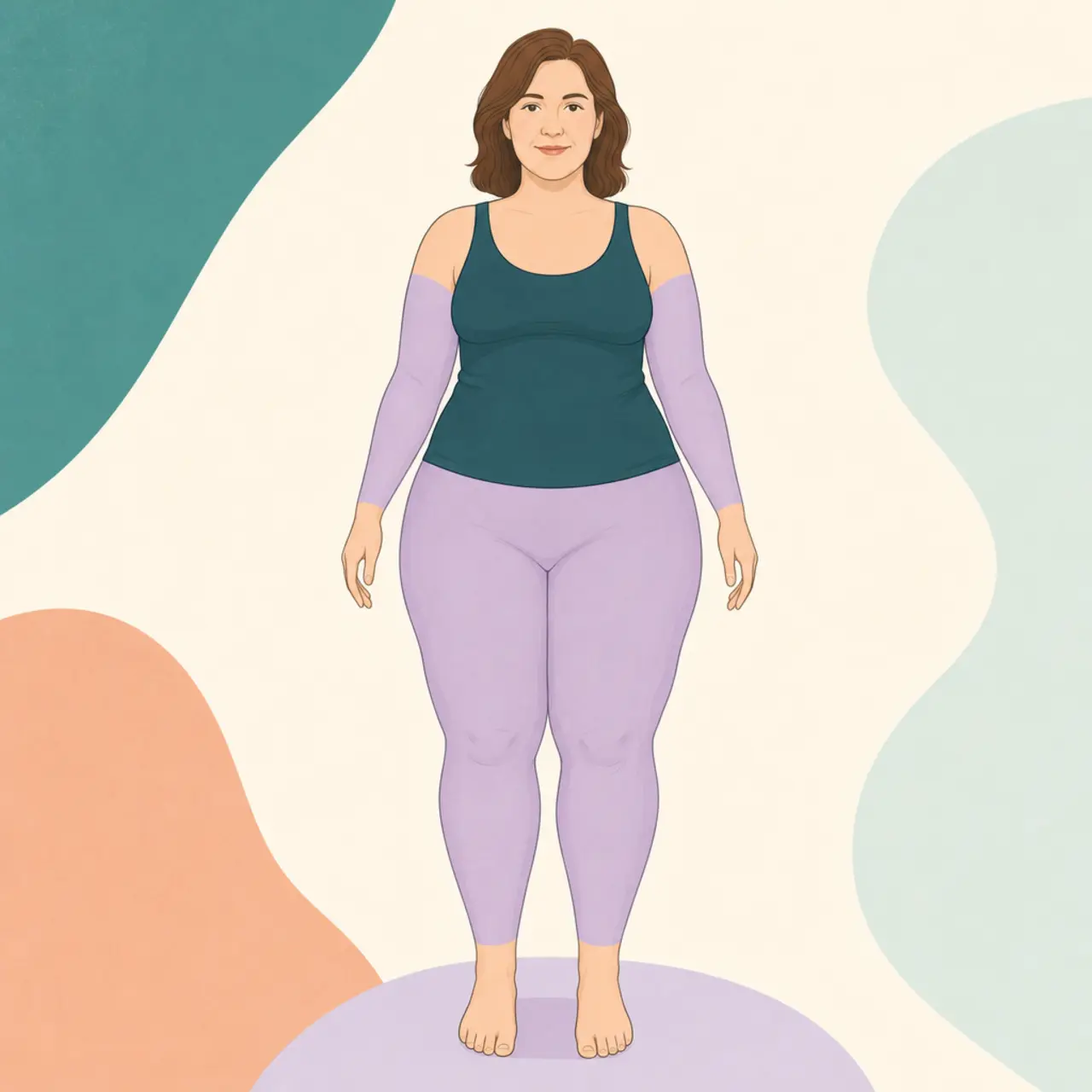
Can you be slim and still have lipedema? Yes.
- Researched against current medical guidelines
- Every claim sourced & linked to a named authority
- Independent — we don’t sell surgery
- Not a substitute for your doctor.
Lipedema isn't about overall weight. Slim and athletic women can have it — typically with a noticeably larger, tender lower half, easy bruising, and legs that won't slim down no matter how lean the rest of them gets. A normal BMI does not rule out lipedema.
On this page
Why is lean lipedema so often missed?
The dominant image of lipedema — in textbooks, medical training, and online — shows large, heavily affected bodies. That image is real but incomplete. It creates a blind spot: when a slim or average-weight woman walks in with painful, disproportion legs, the doctor's mental model doesn't match, so lipedema isn't considered.
You're not imagining it
"I'm not big enough to have lipedema" is one of the most common things people with lean lipedema say — often after being told the same by a doctor. A normal BMI does not rule out lipedema. The diagnosis is based on the pattern of fat, the pain, and the diet-resistance — not a number on the scale.
Lipedema awareness training often focuses on late-stage, large-body presentations because those are the ones that were historically studied. Early-stage lipedema in normal-weight women is almost certainly more prevalent than the clinical literature reflects — it is simply less likely to be documented.
What are the signs of lipedema in slim women?
The core signs are the same as in any presentation, but the contrast may be more dramatic because the upper body is visibly lean:
- Disproportionate lower body — your legs and hips are noticeably larger relative to your upper body, even when your overall weight is normal or low.
- Tenderness and pain — the fat in your legs (and possibly upper arms) is tender when pressed, aches after standing or sitting, or hurts when knocked.
- Easy bruising — bruising that appears with minimal cause, often on the thighs and lower legs.
- Cuff sign — the enlargement stops at the ankles; your feet stay normal-sized.
- Diet-resistance — your upper body responds to diet and exercise, but the lower-body fat holds firm regardless of how lean you get.
- Nodular texture — pea- or rice-like bumps felt under the skin of the thighs or upper arms when you press gently.
The "skinny fat" feeling
Some people with lean lipedema describe feeling "squishy" or "jiggly" in a way that doesn't match their fitness level — they can be very fit with well-trained muscles, yet the overlying fat in their lower body feels soft, heavy, and separate from their muscles. This is consistent with lipedema tissue, which has a different texture from ordinary fat.
Not all lipedema looks dramatic
The "size 6 on top, size 14 on bottom" picture gets most of the attention, but many presentations are much subtler — particularly at Stages 1 and 1.5. A woman with lean lipedema might have:
- Relatively normal-looking legs with mild fullness around the inner knees
- Slight heaviness and tenderness in the thighs that doesn't match her overall build
- Upper arms that feel soft and bruise easily, disproportionate to the rest of her arms
- A long history of being told her legs look fine — while she knows something isn't right
These presentations are real lipedema. Early diagnosis and early management — compression, lymphatic movement, appropriate exercise — can meaningfully slow progression.
Why BMI doesn't rule out lipedema
BMI measures total weight relative to height. It doesn't measure where fat is distributed, whether it's painful, or whether it responds to diet. Someone with lean lipedema might have a BMI of 22 — squarely in the "normal" range — while still having significant lipedema fat in the legs that causes daily pain.
The diagnostic criteria for lipedema are clinical, not numeric: symmetrical disproportionate fat, tenderness to pressure, easy bruising, sparing of the feet, family history, and onset at hormonal transitions. None of these require a high BMI. (Delphi Consensus, 2026)
Sources
- Delphi Consensus on Lipedema Diagnosis, Nature Communications 2026 nature.com
- Aday et al. — 707-patient US survey, Vascular Medicine 2024 pmc.ncbi.nlm.nih.gov
- Lipedema Foundation lipedema.org